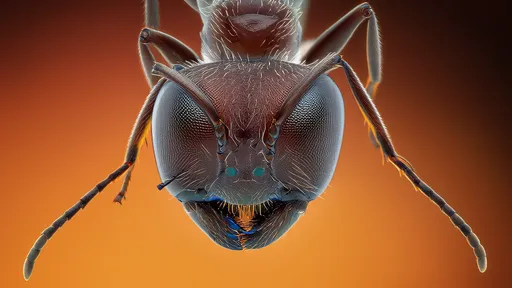
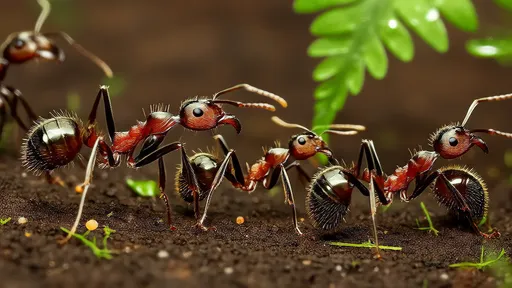
In the intricate world of computational intelligence, nature has long served as a profound source of inspiration. Among the most fascinating models derived from biological systems is the Ant Colony Optimization (ACO) algorithm, a metaheuristic that mimics the foraging behavior of real ant colonies. A particularly compelling case study within this domain focuses on the Argentine ant (Linepithema humile), a species known for its remarkable collective efficiency in locating and exploiting food sources. This article delves into the sophisticated computational model that translates the Argentine ant's path-finding prowess into a powerful tool for solving complex optimization problems.
The foundational principle of the ACO algorithm lies in the ants' use of pheromone trails. As ants forage, they deposit chemical signals on the ground. Other ants detect these pheromones and are more likely to follow paths with stronger concentrations, which in turn leads to further reinforcement of that trail. This creates a positive feedback loop where the shortest or most efficient path to a food source becomes increasingly pronounced. The Argentine ant, with its highly cooperative and invasive nature, exhibits this behavior with exceptional clarity, making it an ideal biological prototype for computational modeling.
Researchers have developed detailed mathematical frameworks to emulate this process. Each artificial "ant" in the simulation represents a potential solution constructor. As it traverses a graph representing the problem space—be it a network for the Traveling Salesman Problem, a routing path in telecommunications, or a scheduling grid—it probabilistically chooses its path based on the pheromone intensity and heuristic information, such as the distance between nodes. The pheromone levels are updated dynamically: evaporation prevents stagnation and convergence on suboptimal paths, while deposition reinforces promising routes. This balance between exploration and exploitation is crucial for the algorithm's success.
The application of this bio-inspired model to the Argentine ant's behavior is not merely theoretical. Field studies have meticulously documented the foraging patterns of these ants, noting their ability to establish efficient trails through complex terrains with minimal individual cognition. This empirical data has been instrumental in refining the ACO parameters, such as the pheromone evaporation rate and the relative importance of heuristic versus pheromone information. By aligning the algorithm's mechanics with observed biological phenomena, scientists have enhanced both the authenticity and the performance of the computational model.
One of the most significant advantages of the ACO algorithm, inspired by the Argentine ant, is its robustness in handling dynamic and noisy environments. In nature, food sources deplete, obstacles appear, and conditions change; ant colonies adapt their trails accordingly. Similarly, the artificial system can be designed to respond to real-time changes in the problem constraints. For instance, in network routing, if a node fails or traffic congestion occurs, the algorithm can redistribute the "ants" to find new optimal paths without requiring a complete reset, showcasing its resilience and practicality.
Moreover, the swarm intelligence inherent in this model demonstrates emergent problem-solving capabilities that surpass the sum of its parts. No single ant possesses a global overview of the environment, yet the colony collectively arrives at an efficient solution. This decentralized, self-organizing approach is particularly valuable for large-scale systems where centralized control is impractical or inefficient. The Argentine ant model, therefore, offers a blueprint for designing distributed algorithms that are scalable, flexible, and robust.
Despite its strengths, the ACO algorithm is not without challenges. Parameter tuning—such as determining the optimal number of ants, evaporation rate, and influence of heuristic data—can be complex and problem-dependent. Over-reliance on pheromone trails might lead to premature convergence on local optima, a pitfall that researchers mitigate by incorporating techniques like elitist strategies or max-min pheromone limits. Continuous research aims to enhance the algorithm's adaptability and convergence speed, drawing further insights from the ever-evolving study of ant ethology.
In conclusion, the fusion of entomology and computer science through the Ant Colony Optimization algorithm exemplifies the power of interdisciplinary research. The Argentine ant, with its efficient foraging strategies, provides a natural template for developing computational models that address some of the most daunting optimization challenges in engineering, logistics, and data science. As we continue to decode the mysteries of swarm intelligence, the humble ant remains a testament to the sophistication and elegance of evolutionary design, inspiring algorithms that are not only effective but also intrinsically aligned with the rhythms of the natural world.
By /Aug 27, 2025

By /Aug 27, 2025

By /Aug 27, 2025

By /Aug 27, 2025
By /Aug 27, 2025
By /Aug 27, 2025

By /Aug 27, 2025
By /Aug 27, 2025

By /Aug 27, 2025

By /Aug 27, 2025

By /Aug 27, 2025
By /Aug 27, 2025

By /Aug 27, 2025
By /Aug 27, 2025
By /Aug 27, 2025
By /Aug 27, 2025

By /Aug 27, 2025
By /Aug 27, 2025

By /Aug 27, 2025

By /Aug 27, 2025